


PERMISSIONS REQUIRED: Must be Therapists assigned to Case or Administrator.
You can add diagnosis codes to a Client Case and classify them as Primary, Secondary, Tertiary and Quaternary. Diagnosis codes and their classifications will appear on initial assessments and progress notes. Once the Client Assessment is completed and signed locked, you may not edit a signed Assessment, but you can Add an Addendum to an Initial Assessment Form for diagnosis edits and additional Notes.
NOTE: You can prevent your staff from submitting and signing progress notes that do not have a diagnosis code entered. See Prevent Staff from Submitting/Signing Progress Note Without Diagnosis for more information.
Jump to Section:
IMPORTANT: Diagnosis codes will pull into treatment plans & progress notes based on when the document is created.
- If the document is created before codes are entered on the initial assessment, the codes will not display automatically and you will need add an addendum to that Note so the existing Diagnosis are included.
- If the document is created after codes have already been entered on the initial assessment the codes will display automatically from the initial assessment or most recent addendum. This is also the case if you select + Copy from last session to create a new Progress Note.
- Any changes to diagnosis codes will not affect any existing progress note or treatment plan. If you want the updated codes to display on any existing documents you will need to add an addendum to that Note so that the existing Diagnosis is included.
Add Diagnosis to Initial Assessment & Diagnosis Codes
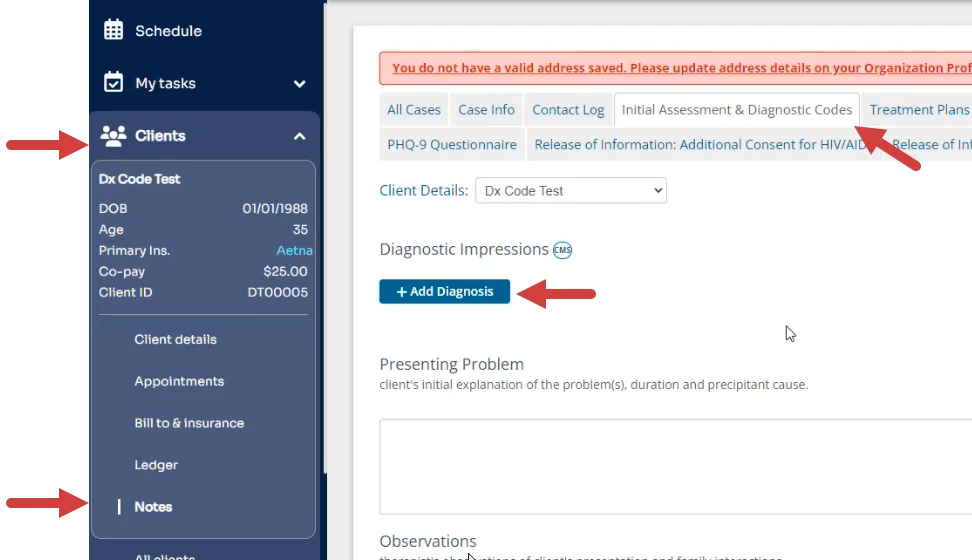
- Locate Client and open Client Profile.
- Click Notes in left side menu.
- If a Case has not been created for this Client a new one will be created.
- If there are multiple Cases you are assigned to, you will need to select appropriate Case.
- Click Initial Assessment & Diagnostic Codes tab inside the Case.
- Click the + Add Diagnosis button.
- The Diagnosis codes pop-up opens with four code & classification search fields available. There is a field for you to add a diagnosis code description if needed.
- You can only classify up to four billable codes. Any additional codes will be unclassified.
NOTE: Click +Add diagnosis code to add as many fields as needed.
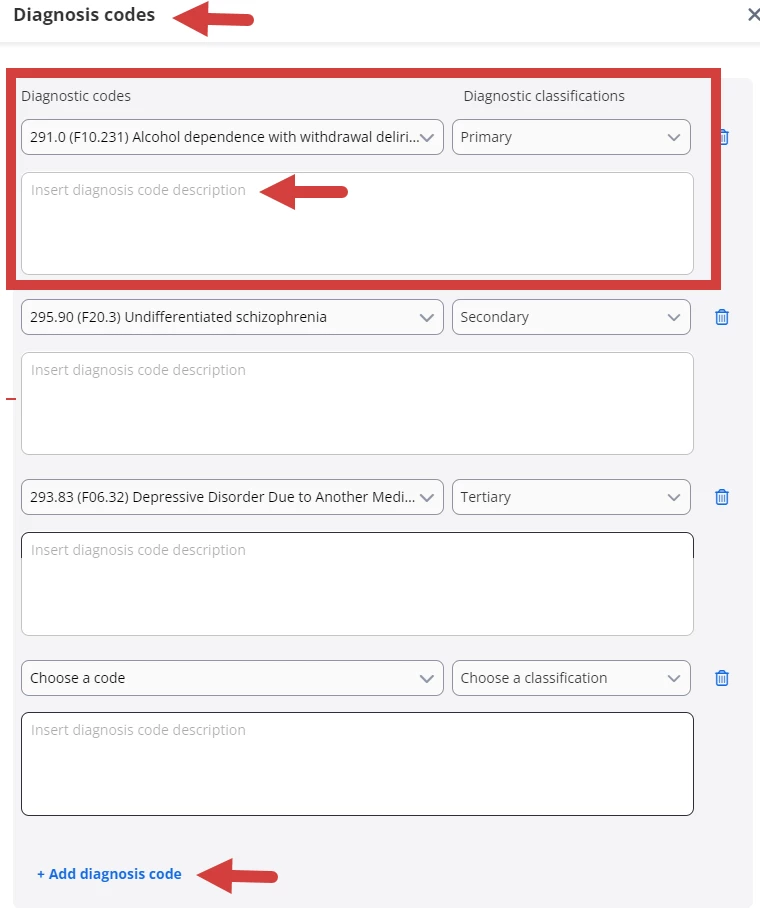
- You can only classify up to four billable codes. Any additional codes will be unclassified.
- Click in the fields to search for diagnosis codes and assign a classification if needed (Primary, Secondary, Tertiary, Quaternary).
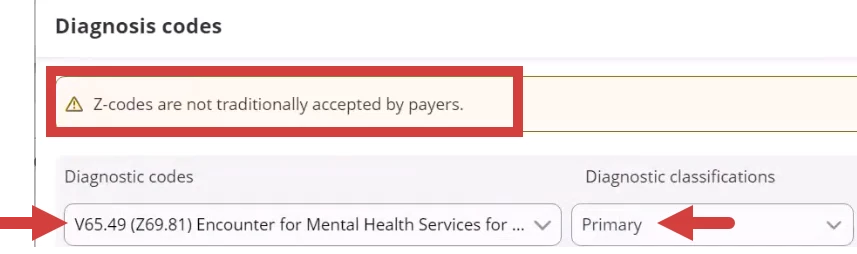
NOTE: Z-codes classified as Primary may not be accepted by payers. You will see this warning message.
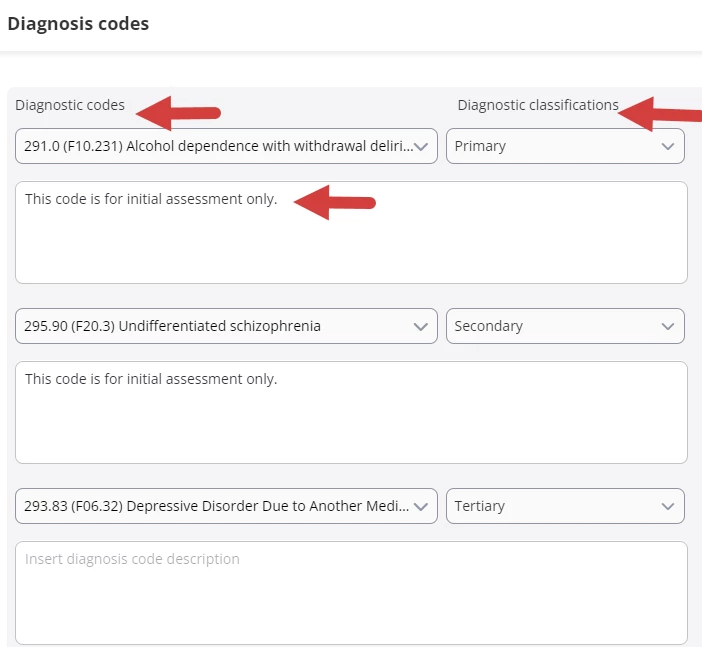
- Enter a description for the diagnosis code if needed.
NOTE: The description will display on printed initial assessments and progress notes.
- Click Save at the bottom of the diagnosis code entry modal.
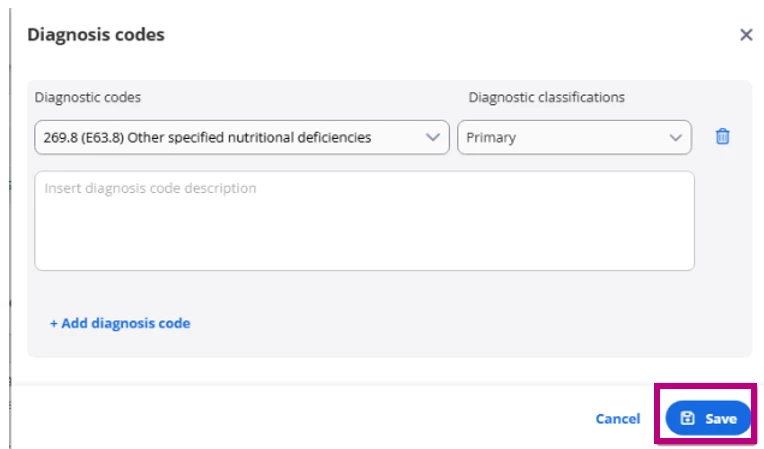
- Click Save again in the Initial Assessment and Diagnosis Code Form.

NOTE: Non-billable codes have a blue exclamation point icon. They cannot be classified.
- The diagnosis codes, classification and billable status show on the assessment under Diagnostic Impressions. Billable codes will appear on billing documents, like the claim & CMS 1500 in the order they were classified.
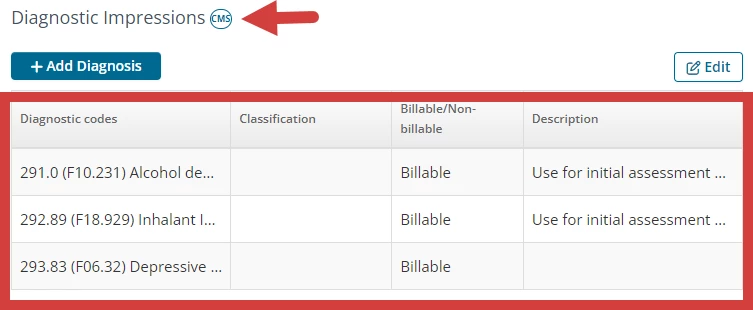
NOTE: Hover over the code to see a description.
Add Diagnosis to Document Created Before Codes Entered on Initial Assessment
- Open the existing progress note or treatment plan.
NOTE: If not Signed, it will pull the information entered under Initial Assessment and Diagnosis form automatically, if Signed, an Addendum will need to be entered so the current Diagnostic Codes are pulled.

- You can add/edit the Diagnosis Codes as needed under the Addendum.
NOTE: This will only affect the specific Progress Note or Treatment Plan not the Diagnosis for other Documents.
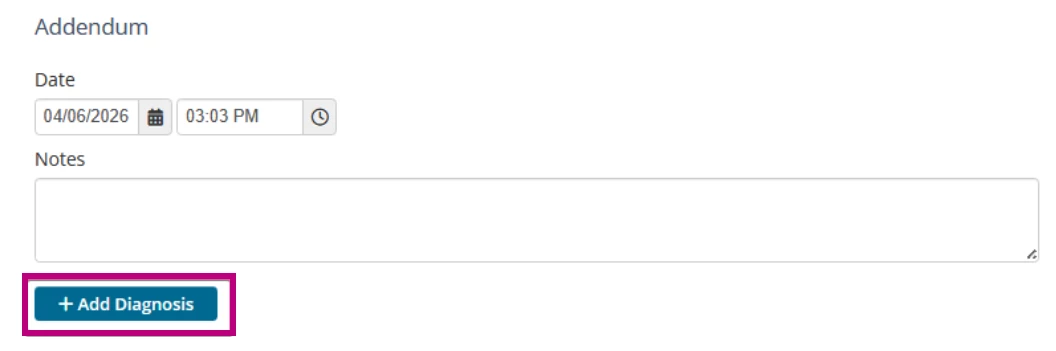
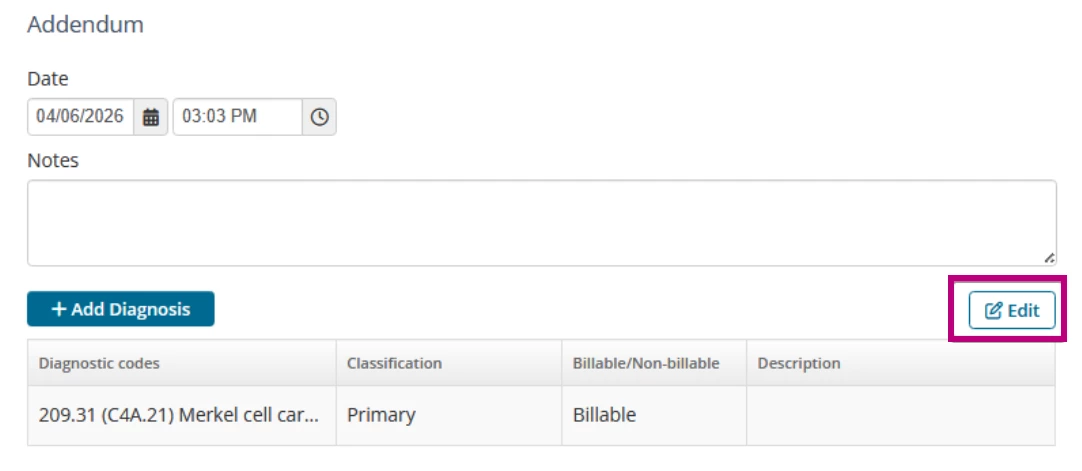
- Enter the Diagnosis as needed and click Save.
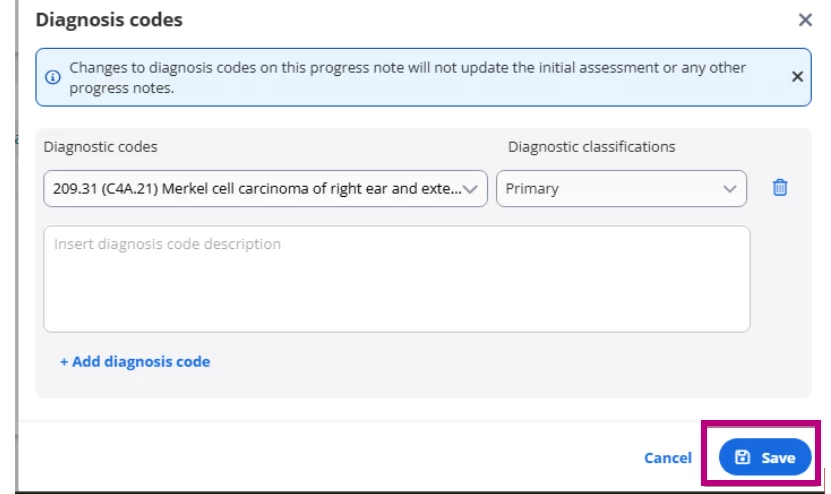
- Click Save.
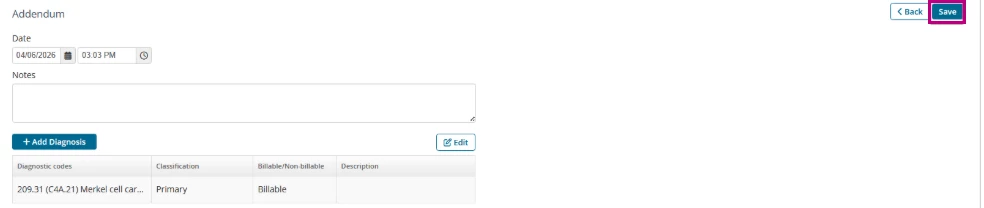
Add Diagnosis to Document Created After Codes Entered in Initial Assessment
- Create a new progress note or treatment plan after you have entered diagnosis code(s) in the Initial Assessment as explained above.
- All codes entered will automatically display from the initial assessment or most recent addendum.
NOTE: Diagnosis codes entered in the initial assessment will not pull into treatment Plan & Progress Note drafts.