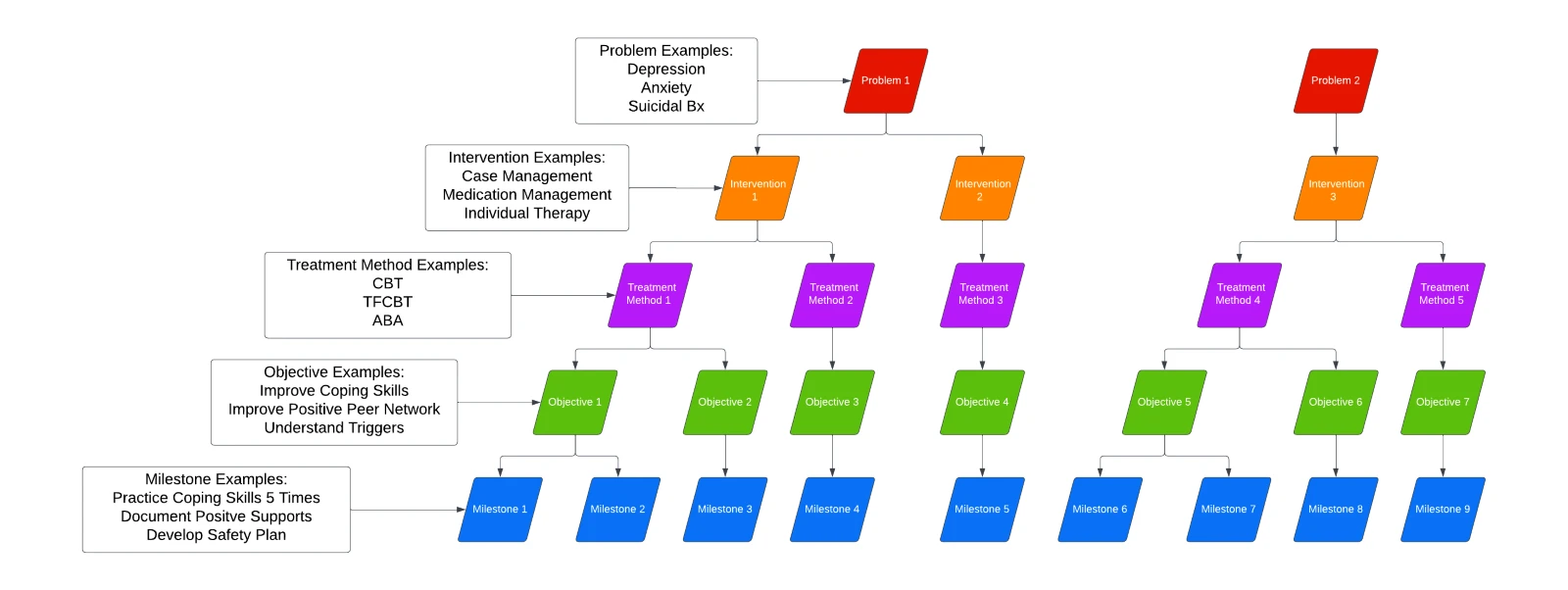
Treatment Plan - document completed by clinical staff to cover a period or “cycle” of treatment whereby clinical staff outline the needs/problems of a patient, the goals of treatment, objectives, interventions, milestones, and modality of treatment
Treatment Plan Cycle - the period between an initial treatment plan and the next full review or the period between a full review of the plan and the next full review
Treatment Plan Review - after an initial plan is created a review should be a full evaluation of the treatment plan for a client whereby the clinician may alter the plan based upon current information and the progress and struggles of the client toward treatment goals. All elements of the treatment plan may be added removed or updated accordingly during this process and there may be regulations mandating the frequency of a review
Treatment Plan Addendum - this is used to make small modifications to a client’s treatment plan between full reviews. There may be strict rules for when a treatment plan can be considered for an addendum versus a full review. Typically, an addendum does not alter the cycle dates of the plan or alter the modalities for the plan of care. This is not a rule and jurisdictions may have more detailed rules. In the system’s treatment planning system, an addendum requires signatories to re-sign the plan.
Problem - sometimes also referred to as “Need” reflects primary issues to be addressed during a treatment cycle
Intervention is to specify the type of treatment used, such as CBT, IOP, ABA, etc.
Treatment Method - this will specify the modality of treatment whereby the clinician is setting the frequency and intensity (1 time per month or three times per week etc.) of the sessions as well as the type of sessions (individual vs. group vs. family etc.)
Objective - is specifically how a problem will be addressed, such as increasing proficiency with using coping skills, improving meta cognition, improving social supports, life skill education etc. This is sometimes referred to as a “goal”. There may be more than one objective for each Treatment Method on the client’s treatment plan.
Milestone - represents a measure of success toward an objective will practice coping skills five times a day for 14 days, will identify a primary support and notify the person that they have been designated as such. This is sometimes referred to as an “objective”. There may be more than one milestone for each objective.
Assessment - a form that is designed to measure a clinically significant attribute such as mood, thought patterns, social determinants of health, etc. In the system’s treatment planning system, if and when customer agencies can use whatever assessments they choose, they may use any form as an “assessment” to associate an outcome with a problem in a client’s treatment plan provided the appropriate SQL view has been created.